On Friday, March 13, if you had told me that the feelings I was having around 7 p.m. would ultimately end up causing me to have a defibrillator installed, I wouldn’t have believed you.
I’d had chest discomfort, shoulder pain and lower back pain, and just felt bad. We chalked it up to gas — I’d eaten a lot of questionable foods in that time frame, including some midnight Chinese food in Jacksonville on Thursday after seeing comedian Matt Rife.
It had even kept me up late enough on Sunday that I worked from home on Monday. Tuesday went by without any events. But Wednesday said “hold my beer.”
March 18 started like any other day. I had lunch, ran errands, stopped by Home Goods and went back to the office. I felt completely fine — until I didn’t. The same feelings came back, only stronger, along with sweating, confusion and a struggle to breathe. The ambulance took me to East Georgia Regional Medical Center, where they suspected a heart attack. I couldn’t believe it — because I know I’m not the fitness queen we all aspire to be, but I didn’t think I was that bad. (That was very much my internal monologue at the time.)
They took me for a cath and discovered I had SCAD — Spontaneous Coronary Artery Dissection — a tear in a coronary artery wall that caused a leak and disrupted my heart’s ability to pump properly because blood was getting trapped where it shouldn’t.
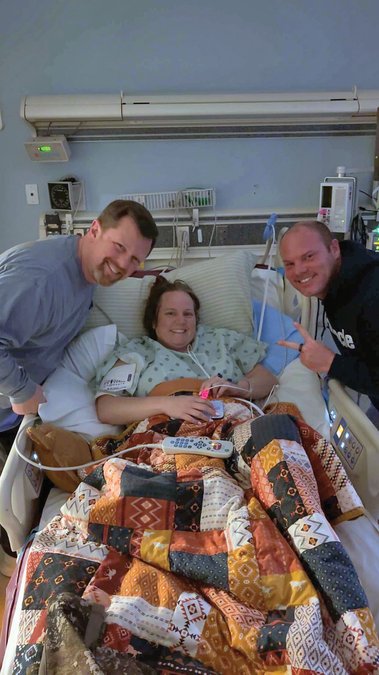
After the cath, I was talking with the doctor when everything suddenly blurred. The next thing I remember, I was waking up, drenched in sweat, with the entire cath team — and a few extra people — around my bed. My tongue was bloody, my chest hurt, and I suddenly had more IVs than I remembered.
I remember asking, “Did I die?”
Silence.
I asked again.
Still silence.
Then, finally: “We shocked you because you went out of rhythm.”
Later I found out that Jason, my mom and my dad had heard the “Code Blue” over the hospital intercom.
I had to be transferred to St. Joseph’s to see the “heart electrician.” I know that’s not the technical term, but it felt accurate at the time.
When I left the hospital after my SCAD heart attack, I knew life would look different for a while. I knew there would be medications, follow-ups, restrictions, recovery instructions. What I didn’t fully understand in those early days was that some of those changes would not be temporary.
One of them sits under my skin now — a small implanted defibrillator that monitors my heart and is designed to step in if it ever goes out of rhythm again.
It is strange to live with something like that. Reassuring in theory, unsettling in practice. Most days I don’t think about it constantly, but I also never forget it’s there. It is a reminder I didn’t ask for, but one I now carry everywhere I go.
The truth is, recovery has not looked like I expected it to. I thought the hardest part would be the emergency itself — the ambulance, the hospital, the procedure, the words I had never heard before suddenly becoming part of my life. But what I’ve learned is that the emergency is only the beginning of a much longer adjustment. There is a version of survival that looks like relief on the outside, and then there is everything that happens when the noise settles and you are left trying to understand what your body has been through.
That part has taken time to process in ways I didn’t expect, not just medically but mentally. There is a strange weight that comes with having something serious happen to your body that doesn’t match the assumptions people tend to make about what that kind of thing “should” look like. At my cardiologist’s office, a glance around the waiting room shows I’m not your stereotypical patient. I’ve had to sit with the reality that heart attacks don’t always announce themselves in familiar ways, and they don’t always happen to the people we subconsciously expect them to. This one didn’t come with warning labels I knew how to read.
But the physical recovery has almost been easier to understand than the emotional one.
The body heals in measurable ways. Incisions close. Medications stabilize things. Appointments mark progress. But the mind doesn’t move in the same straight lines. There are still moments when I am more aware of my heartbeat than I ever was before, when my body feels like something I am simply listening to instead of living in. And there is the quieter part of recovery that no one really prepares you for — the way your sense of safety inside your own body has to be rebuilt, piece by piece.
Living with a defibrillator adds another layer to that. It is easy to explain medically, harder to explain emotionally. It is there as protection, as prevention, as intervention, if needed. But it also represents something else: the fact that my heart needed help in a way I never imagined. Some days I find comfort in it. Other days I am aware of it in a way that feels harder to name. Both are true at the same time.
What I didn’t expect, just as much as the medical side, was what this would reveal about people.
There is something about a crisis that clarifies relationships quickly. Some people showed up immediately and without hesitation. They didn’t ask what to do — they just did it. They checked in, they stayed close, they sat in waiting rooms, they answered calls, they followed updates, they made sure I wasn’t alone in any part of it.
Recovery doesn’t stay contained to the hospital. Life keeps moving. Responsibilities return. Conversations shift from emergency updates to everyday realities. And in that space, you start to see who continues to show up when things are no longer urgent, just ongoing. That has been one of the clearest and hardest lessons of all of this — not just who appears in the crisis, but who remains when the crisis is over but the recovery is still very real.
My family has carried their own version of this experience, and that is something I think about more than I can always say out loud. I was the one physically going through it, but they were living through it as well — watching, waiting, not knowing what the outcome would be in real time.
My husband held it together until he was out of sight. My dad, usually a flight risk at the sight of a needle, stayed by my bedside when I was having IVs changed. My mom brushed my hair like I was a kid again. In those moments, I felt like a kid again — I needed my parents. My aunt immediately came to our house to take care of our dogs, ready to stay as long as needed. My sister sat in the waiting room until she could see me and held me while I cried — from pain, fear and overwhelm all at once.
I have seen fear in the faces of people I love in a way I won’t forget, the kind of fear that words don’t truly explain.
And I’ve had to understand what it means that I am still here after that. Not in a dramatic sense, but in a very real one. I am still here, still recovering, still moving through ordinary days after something that was anything but ordinary.
In the months since, I’ve started therapy, not because I needed someone to explain what happened, but because I needed help figuring out how to live inside the aftermath of it. There is a difference between knowing something medically and your body believing it is safe again. Therapy has helped me give language to things I didn’t fully know how to name — the fear that shows up without warning, the way your attention shifts to things you used to ignore, how your sense of “normal” quietly changes.
I still don’t know what the long-term version of all of this looks like. I don’t know how often I’ll think about it as time goes on, or how much space it will take up in my life a year from now, or five.
But I do know I am not the same person.
I am more aware now. More attentive to my body. More honest about what I can and can’t push through.
And I’m still learning, every day, how to live in a body that has been through something I never would have chosen — but is still here, still healing, still mine.